
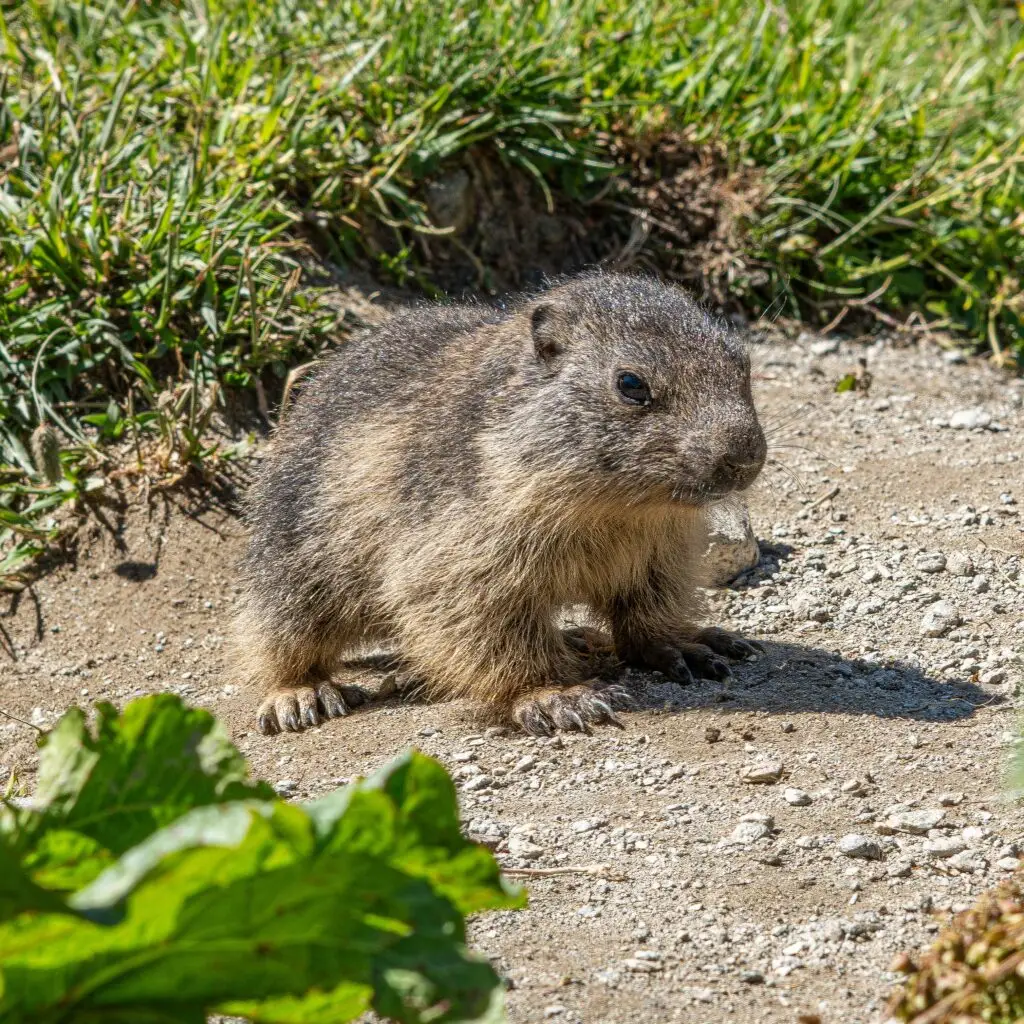
Some encounters turn a good holiday into an unforgettable one. For many families discovering the mountains for the first time, seeing a marmot up close is one of those moments — and children remember it for years.
Around Bozel, marmots take a little effort to find: you need altitude. Below 1,800–2,000m, you won’t see them. But once you reach the alpine meadows, they’re there — often in large numbers. Here are the best local spots.
Family profiles: Discovery Family · Contemplative Family | Season: Summer (April to October)
About the alpine marmot
The marmot is a medium-sized rodent, the symbol of high-altitude meadows. Its stocky body, short ears and powerful clawed feet are perfectly adapted to its burrowing lifestyle. It emits a sharp, piercing whistle at the first sign of danger — often the first clue that a colony is nearby.
Marmots live in family groups: a dominant breeding pair and offspring from successive litters. They are true hibernators, visible only from April to October. Spotting a family with young pups in July or August is particularly magical.
When to spot marmots
Best period: July and August. This is when you can observe complete family groups with their young. The best times of day are early morning and late afternoon — marmots are most active at these times and tend to retreat underground during the hottest part of the day.
Best spots around Bozel
1. Mont Jovet — the local favourite ⭐
The reference spot from Bozel. Marmots are plentiful in the meadows around the refuge and on the slopes below the summit. The refuge sits at 2,350m altitude, inaugurated in 1890 and restored in 2014. Open 13 June to 13 September.
How to get there — 3 options:
- On foot from Mirabozon — Park at La Cour (1,550m), 800m ascent, 3 hours to the refuge. The most scenic option.
- By mountain bike (with or without electric assistance) — Gradual climb on a vehicle track, thrilling descent.
- By car to the refuge — Road becomes a rough track beyond Bozel. Best option for families with young children — park near the refuge and explore the meadows on foot.
Bonus: the refuge serves homemade blueberry tart from locally picked berries. A well-earned reward!
2. Champagny-le-Haut — the easy drive option ⭐⭐
15 minutes by car from Bozel. Park at Laisonnay d’en Bas (1,560m) — marmots here are accustomed to walkers and much less skittish. Almost guaranteed sightings along the path to the Glière refuge. Also excellent for ibex.
Level: T1 · Suitable for all · 15 min drive from Bozel
3. Courchevel — the cable car option ⭐
In summer, several Courchevel lifts operate, giving quick access to 2,000–2,500m altitude — right in marmot territory. Ideal for families who don’t want a long walk. Check operating hours in season.
Tips for a successful sighting
- Be patient and quiet — any loud noise sends them underground. Walk slowly and speak softly.
- Look for burrows — holes in the meadow with fresh earth around them. Sit 20–30m away and wait.
- Listen first — the whistle alarm often comes before you see them.
- Bring binoculars — essential for observing at a safe distance. Children love using them.
- Never feed wildlife — human food is harmful and makes them dependent on walkers.
Making it a game for children
- Marmot quiz — before you leave, learn the basics together. Who will spot the first one?
- Wildlife logbook — each child notes how many they saw, what they were doing, whether they whistled.
- Photo challenge — who gets the best shot? With a smartphone and patience, the results can be impressive.
What else you might see
On these same trails:
- Ibex — especially at Champagny-le-Haut. Rarer but more impressive.
- Chamois — more agile and elusive than ibex.
- Raptors — golden eagles, buzzards. Look up regularly.
Where to stay for wildlife watching around Bozel
From the Chalet École des Cimes in Tincave (1,300m), Mont Jovet is a few minutes’ drive and Champagny-le-Haut is 15 minutes away. The perfect base for combining hikes, wildlife watching and relaxation.